
The Basic Teachings of the Bible · Study 06
The Book of Concord
The Lutheran Confessions
Biblical, catholic, and evangelical: confessing the faith centered in Jesus Christ.
Begin the study ↓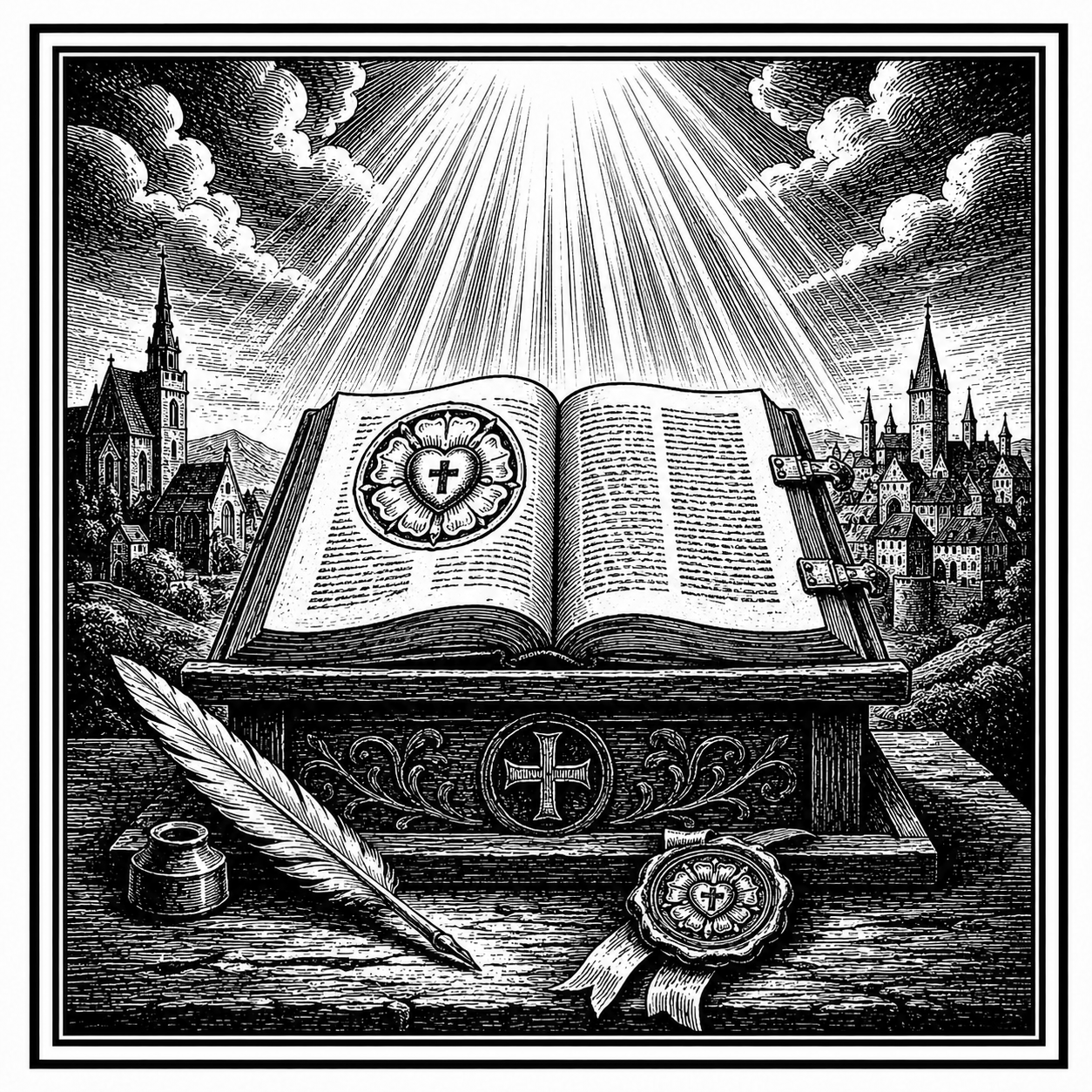
Complete section text from The Basic Teachings of the Bible, pp. 76–83. Discussion questions are companion material added for this online study.
Scripture: The Foundation of Our Faith
The Christian faith begins with God’s Word. The Holy Scriptures of the Old and New Testaments are the inspired Word of God and the foundational authority for everything the Church believes, teaches, and confesses.
The Bible does not receive its authority from the Church. Rather, the Church receives God’s Word and lives under its authority.
“All Scripture is God breathed and is useful for teaching, for rebuking, for correcting, and for training in righteousness.”
2 Timothy 3:16
For this reason, Christians have historically confessed that Scripture alone is the final authority for Christian doctrine. This does not mean that Christians have no creeds, teachers, or confessions of faith. It means that all Christian teaching must remain under the authority of God’s Word.
Scripture judges our confessions. Our confessions do not judge Scripture.
Why Does the Church Have Creeds and Confessions?
From the earliest centuries, Christians found it necessary to state clearly what they believed Scripture teaches. When false teachings arose concerning God, Jesus Christ, salvation, and other central teachings of the faith, Christians responded by confessing the truth together.
The word creed comes from the Latin credo, meaning “I believe.” A creed or confession therefore does not add new revelation to Scripture. It simply says, “This is what we believe the Scriptures teach.”
The Apostles’, Nicene, and Athanasian Creeds are ancient examples of the Church doing exactly this. They summarize the biblical faith concerning the Triune God and Jesus Christ.
The Evangelical Reformation
The reformers of the sixteenth century who came to be called Lutherans understood themselves first of all as evangelical Christians—Christians centered in the evangel, the Good News of Jesus Christ.
They did not intend to start a new church or invent new doctrines. They wanted to call the Church back to the clear teaching of Holy Scripture and to the Gospel of salvation by God’s grace through faith in Jesus Christ.
At the same time, they insisted that they were not rejecting the historic Christian faith. They gladly confessed the ancient creeds and understood themselves to stand in continuity with the catholic Church—that is, the universal Christian Church throughout the ages.
At Augsburg in 1530, the Lutheran confessors declared that they had received nothing in doctrine contrary to “Scripture or the Church catholic.” The Reformation was therefore intended to be not the creation of a new Christianity but the reformation of the Church according to God’s Word.
The Book of Concord
During the Reformation, Lutheran pastors, theologians, princes, and congregations produced several important confessions explaining what they believed Scripture teaches. These documents were eventually gathered together into the Book of Concord, published in 1580.
The word concord means agreement or harmony. The Book of Concord expresses the common confession of the Evangelical Lutheran Church concerning the teachings of Holy Scripture.
Lutherans do not place the Book of Concord alongside the Bible as another inspired authority. Scripture alone is God’s inspired and infallible Word.
The Lutheran Confessions are received because they faithfully confess the teaching of Scripture. They remain under Scripture and are always normed by Scripture.
Holy Scripture — The inspired Word of God—the source, rule, and final authority for Christian teaching.
The Lutheran Confessions — The Church’s faithful public confession of what it believes Holy Scripture teaches.
What Is in the Book of Concord?
The Three Ecumenical Creeds
The Book of Concord begins by confessing the ancient creeds of the universal Christian Church.
The Apostles’ Creed — A brief summary of the Christian faith centered upon the work of the Father, Son, and Holy Spirit. Its basic form developed from the ancient baptismal confession of the early Church.
The Nicene Creed — The great fourth-century confession of the Church concerning the Trinity and especially the full divinity of Jesus Christ. It confesses that the Son is eternally begotten of the Father and is of one divine essence with the Father.
The Athanasian Creed — A more extensive confession of the Trinity and the person of Jesus Christ. It carefully distinguishes the three divine Persons while confessing the one undivided divine essence and teaches that Jesus Christ is fully God and fully human.
Together these creeds demonstrate that the Lutheran Reformation intended to remain firmly rooted in the historic Christian faith.
The Augsburg Confession — 1530
The Augsburg Confession is the central public confession of the Lutheran Reformation. It was presented before Emperor Charles V at Augsburg, Germany, in 1530.
Its twenty-eight articles summarize Lutheran teaching concerning God, original sin, Jesus Christ, justification, the ministry, Baptism, the Lord’s Supper, repentance, the Church, good works, Christian freedom, and other teachings. At its heart is the Gospel that sinners are justified—declared righteous before God—by grace through faith in Jesus Christ, apart from their works.
The Augsburg Confession also explains several abuses in the medieval Church that the reformers believed needed to be corrected according to Scripture.
The Apology of the Augsburg Confession — 1531
The word apology here does not mean saying “I’m sorry.” It means a defense. After Roman Catholic theologians criticized the Augsburg Confession, Philip Melanchthon wrote a detailed biblical and theological defense of it.
The Apology gives fuller explanations of many Lutheran teachings, especially original sin, justification by faith, repentance, good works, the Church, the Sacraments, and Christian worship. Its extensive discussion of justification by grace through faith in Christ is one of the clearest presentations of the Gospel in the Lutheran Confessions.
The Smalcald Articles — 1537
Martin Luther wrote the Smalcald Articles when it appeared that a church council might soon be held. He summarized the teachings that stood at the heart of the Reformation and distinguished matters of human custom from teachings that could never be surrendered because they belong to the Gospel itself.
At the center stands the saving work of Jesus Christ: Jesus died for our sins and rose again for our justification. Everything in the Church must serve this Gospel rather than obscure it.
The Treatise on the Power and Primacy of the Pope — 1537
Written primarily by Philip Melanchthon, the Treatise on the Power and Primacy of the Pope explains the Lutheran understanding of authority and ministry in the Church.
It rejects the claim that the pope possesses divine authority over the entire Christian Church. Instead, Christ alone is the Lord and Head of his Church. Pastors and bishops exercise spiritual authority through the ministry Christ has entrusted to his Church—the preaching of God’s Word, the forgiveness of sins, and the administration of the Sacraments.
Luther’s Small Catechism — 1529
Martin Luther wrote the Small Catechism to help parents, pastors, and ordinary Christians learn the basic teachings of the Christian faith. It explains the Ten Commandments, the Apostles’ Creed, the Lord’s Prayer, Holy Baptism, Confession and Absolution, and the Sacrament of the Altar.
Its simple questions and answers have taught generations of Christians to understand the faith and live in the promises of God.
Luther’s Large Catechism — 1529
The Large Catechism covers the same basic teachings as the Small Catechism but explains them in much greater depth. Originally intended especially to help pastors and teachers, it is filled with Luther’s practical and pastoral explanations of Christian faith and life.
The Large Catechism repeatedly emphasizes God’s gracious giving. God gives us his Word, his name, his promises, his forgiveness, his Sacraments, and ultimately himself.
The Formula of Concord — 1577
After Luther’s death, disagreements arose among Lutheran theologians concerning several important doctrines. The Formula of Concord was written to resolve these controversies on the basis of Scripture and restore doctrinal unity among the Lutheran churches.
It discusses such subjects as original sin, human free will, justification, good works, Law and Gospel, the proper use of God’s Law, the Lord’s Supper, the person of Christ, church ceremonies, and election.
The Formula begins by making the Lutheran understanding of authority unmistakably clear: Holy Scripture alone is the rule and norm according to which all doctrines and teachers are to be judged.
The Epitome — A shorter summary of the disputed teachings, stating what Lutherans affirm and what they reject.
The Solid Declaration — A fuller explanation of the same teachings, providing more extensive biblical and theological reasoning.
Together they complete the doctrinal writings collected in the Book of Concord.
The Catalog of Testimonies
The original Book of Concord also included an appendix called the Catalog of Testimonies. It gathers statements from ancient Christian teachers concerning the person of Christ, particularly the relationship between his divine and human natures.
Its purpose was to demonstrate that the Lutheran teaching about Christ was not a sixteenth-century invention but stood in continuity with the historic teaching of the Christian Church.
A Biblical, Catholic, and Evangelical Faith
The Lutheran Confessions are therefore not an attempt to create a uniquely “Lutheran” version of Christianity. They are an attempt to say faithfully and clearly:
This is what Holy Scripture teaches.
This is the faith centered in the Gospel of Jesus Christ.
This is the faith confessed by the Christian Church throughout the ages.
This is what we believe, teach, and confess. Biblical — because Holy Scripture is the sole foundational authority for faith and doctrine.
Catholic — because it confesses the historic faith of the universal Christian Church.
Evangelical — because the Gospel of God’s saving grace in Jesus Christ stands at the center of its proclamation.
The Book of Concord does not replace the Bible. It points us back to the Bible and says with the Church:
This is the faith we have received from God’s Word.
This is the Gospel we confess.
This is the faith in which we stand.
Prayer
Almighty God, we thank you for giving your Holy Word to your Church and for preserving the confession of the Gospel through the generations. Keep us steadfast in the faith once delivered to the saints: the faith centered in Jesus Christ, confessed by your Church, and grounded in the Holy Scriptures. Grant that we may not only confess this faith with our lips, but trust your promises with our hearts and faithfully bear witness to Christ in the world. Through Jesus Christ, our Lord. Amen.
Reflect and discuss
- How does the book distinguish Scripture’s authority from the role of the Lutheran Confessions?
- Why does a public confession of faith help the Church teach clearly?
- How does the Gospel of justification by grace through faith shape these writings?