The Basic Teachings of the Bible · Study 05
The Christian Creeds
One faith. Father, Son, and Holy Spirit.
Confess the historic Christian faith with the Apostles’, Nicene, and Athanasian Creeds.
Begin the study ↓
Complete section text from The Basic Teachings of the Bible, pp. 68–74. The book’s modernized English edition of the historic Creeds. Discussion questions are companion material added for this online study.
The Apostles’ Creed
I believe in God, the Father Almighty, Maker of heaven and earth.
And in Jesus Christ, his only Son, our Lord, who was conceived by the Holy Spirit, born of the virgin Mary, suffered under Pontius Pilate, was crucified, died, and was buried. He descended into hell. The third day he rose again from the dead. He ascended into heaven and sits at the right hand of God the Father Almighty. From there he will come to judge the living and the dead.
I believe in the Holy Spirit, the holy Christian Church, the communion of saints, the forgiveness of sins, the resurrection of the body, and the life everlasting. Amen.
In the Apostles’ Creed the word translated “Christian” is catholic, which means universal: the faith confessed by the whole Christian Church.
The Nicene Creed
I believe in one God, the Father Almighty, Maker of heaven and earth and of all things visible and invisible.
And in one Lord Jesus Christ, the only-begotten Son of God, begotten of the Father before all ages; God of God, Light of Light, true God of true God; begotten, not made; of one essence with the Father; through whom all things were made; who for us and for our salvation came down from heaven and was incarnate by the Holy Spirit of the virgin Mary and became man; and was crucified for us under Pontius Pilate. He suffered and was buried. And on the third day he rose again according to the Scriptures and ascended into heaven and sits at the right hand of the Father. And he will come again with glory to judge the living and the dead, whose kingdom will have no end.
And I believe in the Holy Spirit, the Lord and Giver of life, who proceeds from the Father and the Son; who together with the Father and the Son is worshiped and glorified; who spoke by the prophets. And I believe in one holy Christian and apostolic Church. I confess one Baptism for the forgiveness of sins, and I look for the resurrection of the dead and the life of the world to come. Amen.
In the Nicene Creed the word translated “Christian” is catholic, which means universal: the faith confessed by the whole Christian Church.
The Athanasian Creed
Whoever desires to be saved must, above all, hold the catholic faith.
Whoever does not keep this faith whole and undefiled will without doubt perish eternally.
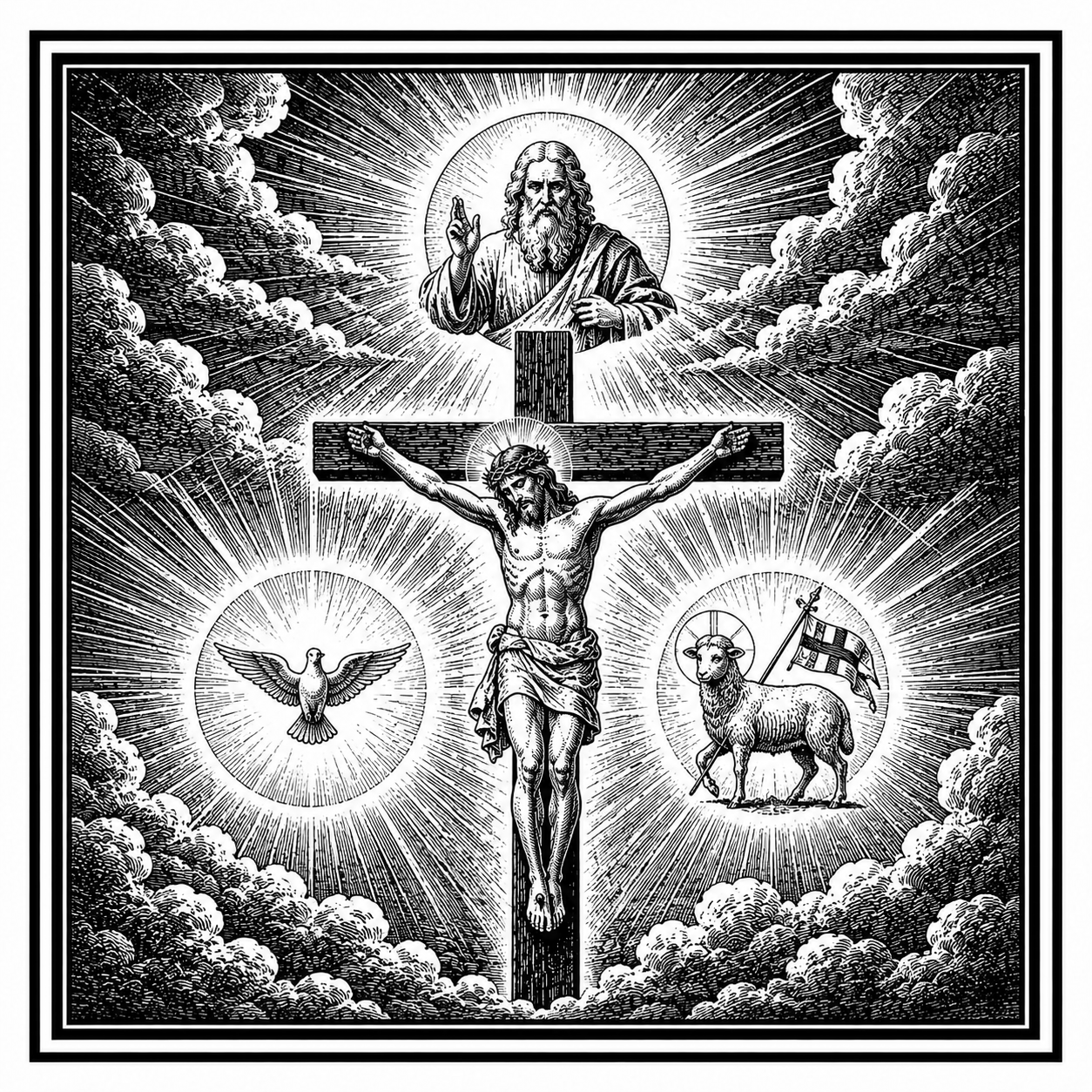
And the catholic faith is this: that we worship one God in Trinity and Trinity in Unity, neither confusing the persons nor dividing the divine essence.
For the Father is one person, the Son another, and the Holy Spirit another.
But the Godhead of the Father, of the Son, and of the Holy Spirit is one: equal in glory and coeternal in majesty.
Such as the Father is, such is the Son, and such is the Holy Spirit.
The Father is uncreated, the Son uncreated, and the Holy Spirit uncreated.
The Father is infinite, the Son infinite, and the Holy Spirit infinite.
The Father is eternal, the Son eternal, and the Holy Spirit eternal.
Yet there are not three eternals, but one eternal; just as there are not three uncreated or three infinite beings, but one uncreated and one infinite.
In the same way, the Father is almighty, the Son almighty, and the Holy Spirit almighty; yet there are not three almighty beings, but one almighty.
So the Father is God, the Son is God, and the Holy Spirit is God; yet there are not three Gods, but one God.
So the Father is Lord, the Son is Lord, and the Holy Spirit is Lord; yet there are not three Lords, but one Lord.
For just as Christian truth compels us to acknowledge each person individually as God and Lord, so the catholic faith forbids us to say that there are three Gods or three Lords.
The Father is made by no one, neither created nor begotten.
The Son is from the Father alone, not made or created, but begotten.
The Holy Spirit is from the Father and the Son, neither made nor created nor begotten, but proceeding.
Therefore there is one Father, not three Fathers; one Son, not three Sons; one Holy Spirit, not three Holy Spirits.
And in this Trinity none is before or after another; none is greater or less than another. But all three persons are coeternal with one another and coequal.
Therefore, as has been said, the Unity in Trinity and the Trinity in Unity is to be worshiped.
Whoever desires to be saved must think this way about the Trinity.
Furthermore, it is necessary for eternal salvation that one also faithfully believe the incarnation of our Lord Jesus Christ.
This, then, is the right faith: that we believe and confess that our Lord Jesus Christ, the Son of God, is both God and man.
He is God, begotten from the Father’s divine essence before all ages; and he is man, born from his mother in this age according to his humanity.
Perfect God and perfect man, composed of a rational soul and human flesh.
Equal to the Father according to his divinity; less than the Father according to his humanity.
Although he is God and man, he is not two Christs but one Christ.
One, however, not by the conversion of the divinity into flesh, but by the taking of humanity into God.
One altogether, not by confusing the two natures, but by the unity of his person.
For just as the rational soul and flesh are one human being, so God and man are one Christ.
He suffered for our salvation, descended into hell, rose again from the dead on the third day, ascended into heaven, and sits at the right hand of the Father, God Almighty.
From there he will come to judge the living and the dead.
At his coming all people will rise bodily and give an account of their own deeds.
And those who have done good will enter eternal life, and those who have done evil will enter eternal fire.
This is the catholic faith. Whoever does not believe it faithfully and firmly cannot be saved.
In the Athanasian Creed, catholic means universal: the faith confessed by the whole Christian Church.
Reflect and discuss
- What gifts of God do these Creeds invite you to receive with trust and thanksgiving?
- Why does it matter that Jesus Christ is truly God and truly human?
- How do the promises of forgiveness and resurrection shape your life today?